


Rosacea: phenotypes, triggers and skincare
Rosacea: triggers, phenotypes and how to care for your skin
Rosacea, sometimes written in Slovak as rozacea (and colloquially known as ružovka), is a chronic inflammatory skin condition. According to a meta-analysis of 32 studies involving 26,519,836 people, it affects 5.46% of adults (Gether et al., Br J Dermatol, 2018). There is currently no cure, but it can be managed over the long term through a combination of a gentle routine, identifying triggers and clinically supported active ingredients.
What is rosacea and how can you recognise it?
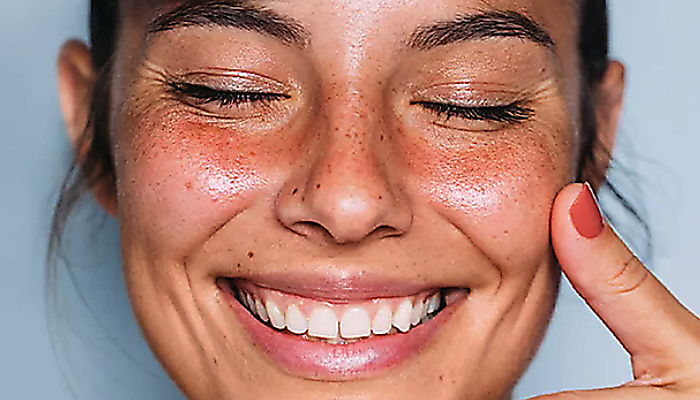
It affects 5.41% of women and 3.90% of men (Gether et al., 2018), peaking between the ages of 45 and 60. Phenotypes often overlap in the same patient, which is why the international ROSCO panel replaced the subtype classification with a phenotype-based approach in 2017 (Tan et al., Br J Dermatol, 2017). It presents as persistent redness on the cheeks, nose, chin and forehead, concentrated in the centre of the face, visible dilated blood vessels (telangiectasia) and, in some patients, inflammatory papules and pustules.
What rosacea is and is not: couperose, acne, eczema
Rosacea follows cycles of remission and flare-ups. Quiet periods alternate with periods when redness intensifies and papules and pustules may appear. The current model of its pathogenesis describes a combination of dysregulated innate immunity (particularly the cathelicidin LL-37 pathway via the enzyme KLK5), inflammation mediated by pattern recognition receptors (PRR), an overabundance of the mite Demodex folliculorum and vascular hyperreactivity (Two et al., J Am Acad Dermatol, 2015). This is the best-supported model, although research is still actively investigating the individual causal steps. A meta-analysis by Chang and Huang confirmed that patients with papulopustular rosacea have a mean Demodex density on the cheeks of 28.6 mites/cm² compared with 6.9 in controls (Chang & Huang, J Am Acad Dermatol, 2017).
Couperose is an older lay term used in Slovak for dilated facial capillaries without a significant inflammatory component. In practice, it overlaps substantially with the erythematotelangiectatic phenotype of rosacea; skincare for both conditions is almost identical.
What rosacea is not: perioral dermatitis, seborrhoeic dermatitis (greasy flakes in the T-zone, which we cover in a separate guide to seborrhoeic dermatitis), contact eczema, acne (rosacea does not involve comedones — a key distinguishing feature) or lupus erythematosus. Telling them apart is not always straightforward; if in doubt, consult a dermatologist. Early stage. Early rosacea is easy to overlook. The first sign is often frequent, persistent flushing — the skin on your cheeks and nose feels hot after exposure to heat, a glass of wine, spicy food or stress, and takes longer than before to return to its usual colour. Gradually, faint but lasting pinkness appears in the centre of the face between episodes, followed by fine visible vessels around the sides of the nose and a feeling that your skin “stings” when using products that previously worked well. If these signs last for weeks or months and cosmetics cannot conceal them, it is sensible to introduce a gentle routine before the symptoms become established.
Rosacea phenotypes and why ROSCO 2017 changed the classification
Historically, rosacea was divided into four subtypes. In 2017, the international ROSCO panel — comprising 17 dermatologists and 3 ophthalmologists — proposed a move to a phenotype-based approach because most patients do not fit neatly into a single category (Tan et al., 2017). The 2019 update confirmed this approach and established complete clearance, meaning no visible symptoms, as the clinical goal of combined treatment and skincare (Schaller et al., Br J Dermatol, 2020). For practical skincare purposes, it is useful to know the original classification:
| Phenotype | Main features | Sensitivity to triggers | When to see a dermatologist |
|---|---|---|---|
| Erythematotelangiectatic ETR |
Persistent redness, visible blood vessels, episodes of flushing. | Very high — sun, heat, stress, alcohol. | If symptoms worsen despite a gentle routine; vascular treatments such as laser or IPL are worth considering. |
| Papulopustular PPR |
Papules and pustules without comedones, persistent redness. | High — heat, sweat, harsh products. | If symptoms persist for 8–12 weeks despite changes to your skincare. |
| Phymatous | Thickening of the skin, rhinophyma; more common in men and in advanced stages. | Lower sensitivity to acute triggers. | Always — skincare cannot reverse this condition. |
| Ocular rosacea affecting the eyes |
Dry, burning eyes, blepharitis, a feeling of something in the eye. | Independent; may also occur on its own. | Always — skincare is not enough; you also need an ophthalmologist. |
Most people have two or more phenotypes at the same time. Our skincare supports the appearance of skin prone to redness and sensitivity. For phymatous changes and ocular involvement, consultation with a dermatologist (and ophthalmologist) is essential. ň
Who is most commonly affected by rosacea?
Prevalence is 5.46% in the general population and 2.39% in dermatology clinics (Gether et al., 2018). Women are affected more often, but men are more likely to progress to the phymatous phenotype. Genetics plays a role: rosacea is strongly associated with fair skin phototypes (Fitzpatrick scale I–II), particularly Celtic and Northern European ancestry (Two et al., 2015). A family history is reported in a substantial proportion of patients, but specific genes that determine the condition have not been identified. The impact goes beyond cosmetics.
A nationwide cohort analysis from Taiwan observed approximately twice the likelihood of a diagnosis of anxiety disorders (aOR 2.31) and depression (aOR 2.21) in patients with rosacea compared with the healthy population (Hung et al., J Affect Disord, 2021); this is an association drawn from an insurance database, and the study does not establish the direction of causality. Higher detection rates of anxiety and depression in patients with rosacea may also reflect the visibility of the condition, more frequent contact with healthcare services or shared risk factors. Persistent redness is visible and is often wrongly interpreted as a sign of embarrassment or alcohol consumption.
What triggers rosacea: identify your own triggers
Rosacea triggers vary considerably from person to person, but a National Rosacea Society survey of 1,066 patients identified the most common factors: sun exposure (81%), emotional stress (79%), hot weather (75%), wind (57%), strenuous exercise (56%), alcohol (52%), hot baths (51%), spicy foods (45%), indoor heating (41%) and hot drinks (36%) (NRS Trigger Survey, 2002).
These figures come from a survey in which patients identified factors that, in their own experience, worsened their symptoms; this was not a controlled measurement of exposure and response. A general list is only a guide; a personal trigger diary is the most useful tool for each patient.
UV radiation is the most common trigger for a specific reason. It dilates superficial blood vessels, damages elastic fibres in vessel walls and activates the cathelicidin inflammatory cascade via KLK5 and LL-37 (Two et al., 2015). Daily mineral SPF is a therapeutic tool for rosacea, not a cosmetic extra.
The situation with alcohol is more nuanced. A 2022 meta-analysis summarised observational studies and found an association between alcohol consumption and rosacea, strongest for red wine (Liu et al., J Cosmet Dermatol, 2022); this is an association, and the direction of causality has not been firmly established. White wine, beer and spirits are associated with less of a reaction. The mechanism involves vasodilation as well as immunomodulatory effects. Stress acts differently, but its effects are just as real. It activates the hypothalamic–pituitary–adrenal axis, raises cortisol and triggers neurogenic inflammation via substance P and CGRP. For rosacea-prone skin, this creates a vicious circle: stress → flushing → visible redness → further stress about its visibility. Managing stress is therefore part of rosacea care: sleep, breathing exercises and physical activity outside acute flare-ups.
Trigger diary. For 4 weeks, record every flare-up: the time, food, weather, emotional state and products applied. After a month, personal patterns will emerge. This tool is cheaper and often more effective than adding a new product to your routine.
Home and traditional remedies for rosacea: what works and what does not
Dozens of traditional remedies for rosacea circulate in Slovakia — black tea compresses, apple cider vinegar, honey left on overnight and chamomile steam baths. Some are neutral; others actively cause harm. Let us briefly look at the most common:
- Cool green or black tea compresses — mildly soothe erythema thanks to polyphenols and the cooling effect. Safe if the tea is lukewarm and applied briefly (5 minutes). They are not a substitute for a skincare routine.
- Apple cider vinegar, lemon juice, bicarbonate of soda — disrupt the skin barrier’s pH and often worsen flushing and stinging. Do not use.
- Steam baths and chamomile inhalations — heat is the third most common trigger in the NRS survey (75%); even “healing” steam can cause blood vessels to react.
- Honey, propolis, royal jelly — honey has some antimicrobial activity, but propolis and bee products are known contact allergens.
- A “rosacea cream” from a high-street shop with no ingredients list — if a product contains alcohol denat., menthol or essential oils, it is often counterproductive for rosacea. Choose products with a transparent INCI list and clinically proven active ingredients (azelaic acid, niacinamide, ceramides).
The most effective “traditional remedy” is unexciting: lukewarm water, a gentle cleanser, moisturising and daily mineral SPF.
When to see a dermatologist for rosacea (and when to see an ophthalmologist)
Specific criteria for specialist referral are more important than a general “consult your doctor”. We recommend seeing a dermatologist in these situations:
- Rapid progression over weeks — visible worsening despite a gentle routine.
- Papules and pustules persisting for 8–12 weeks despite changes to your skincare — AAD first-line topical options include azelaic acid 15% gel, metronidazole 0.75–1% and ivermectin 1% (Two et al., 2015 Part II).
- Phymatous changes — visible thickening of the skin, especially on the nose. Skincare alone is not enough here.
- Any eye symptoms (ocular rosacea) — dryness, burning, a gritty feeling in the eyes, blepharitis. Ocular involvement is reported in up to 50% of rosacea patients (Farshchian & Daveluy, StatPearls, 2023) and may occur without skin symptoms. Untreated ocular rosacea damages the cornea over time (van Zuuren, N Engl J Med, 2017). If you have eye symptoms, also see an ophthalmologist.
This article is educational and does not replace professional advice. If you are unsure about the diagnosis or symptoms are progressing rapidly, see a dermatologist before introducing new active ingredients.
How to manage rosacea: active ingredients, a routine and why natural skincare makes sense
Rosacea management has three pillars: gentle cleansing, mineral SPF and targeted active ingredients. A 2021 consensus of 9 dermatologists states the roles clearly: medical treatment of rosacea is led by a dermatologist, while over-the-counter skincare forms an equally important foundation, not an optional extra (Baldwin et al., J Drugs Dermatol, 2021).
Which active ingredients really work for rosacea?
The combination of azelaic acid, niacinamide and ceramides has the strongest clinical evidence for rosacea; Centella asiatica is a complementary ingredient supported by evidence for its mechanism of action.
Azelaic acid is a naturally occurring dicarboxylic acid (found in barley, wheat and rye). The American Academy of Dermatology lists it as a first-line topical treatment for papulopustular rosacea. At a concentration of 15% (gel), a randomised study found good to excellent improvement in 78% after 15 weeks; metronidazole 0.75% achieved 64% in the same study (Elewski et al., Arch Dermatol, 2003, n = 251). It acts through three mechanisms at once: inhibition of the enzyme KLK5 (which catalytically activates cathelicidin LL-37), antimicrobial activity against Cutibacterium acnes and Staphylococcus epidermidis, and mild inhibition of tyrosinase, which reduces post-inflammatory hyperpigmentation after symptoms have subsided (Schulte et al., J Drugs Dermatol, 2015). We use it at cosmetic concentrations as part of gentle skincare for sensitive skin that reacts with redness. More detail is available in our separate guide to azelaic acid.
Niacinamide (vitamin B3) has similarly strong evidence. In a randomised study, twice-daily application of 2% niacinamide in a moisturiser reduced erythema values from 379.9 ± 106.8 to 333.6 ± 73.5 AU after 4 weeks (Draelos et al., Cutis, 2005, n = 50) and improved stratum corneum function.
Niacinamide does not stimulate blood vessels in the way conventional retinol does, so reactive skin usually tolerates it well. Find out more about the mechanism in our blog post on niacinamide.
Centella asiatica provides pentacyclic triterpenes (asiaticoside, madecassoside), which soothe skin prone to inflammatory reactions and support microcirculation without dilating blood vessels. For context and clinical data, see our guide to Centella asiatica (CICA).
Ceramides + panthenol support the barrier. The consensus of 9 dermatologists (Baldwin et al., 2021) explicitly identifies ceramides, hyaluronic acid and niacinamide as the barrier-supporting core of rosacea skincare. A weakened barrier is part of rosacea’s pathogenesis, not just a consequence.
Mineral SPF (zinc oxide, titanium dioxide) is recommended by the consensus over chemical filters: patients with rosacea often report burning and a temporary worsening of erythema with chemical filters. V
Dulcia: why we developed the Plus – Upokojenie a Rosacea range
We began formulating the Plus – Upokojenie a Rosacea range when customers with reactive skin repeatedly told us that most available azelaic acid serums made their skin burn.
We based our Plus – Upokojenie a Rosacea (20 ml) serum on azelaic acid at a concentration chosen for daily tolerance by reactive skin, rather than the maximum effect from a single application, complemented by niacinamide (vitamin B3, INCI Niacinamide) — an ingredient whose effect on visible erythema at a 2% concentration in a moisturiser was documented in a randomised study of 50 patients (Draelos et al., 2005).
The effect of a particular product depends on its overall formulation. We complemented it with Ceramide Complex CLR™ to replenish the lipid barrier, Glycoin® natural, evening primrose oil, Actibiom, preBIULIN and natural vitamin E. We deliberately left out essential oils and preservatives: with reactive skin, less is more. Current rating: 4 out of 5 stars (22 reviews).
Find out more on the Plus – Upokojenie a Rosacea page or in our guide to azelaic acid.
What to avoid with rosacea
A rosacea routine is also defined by what you leave out.
Alcohol-based and astringent toners disrupt the weakened barrier and trigger erythema. Choose alcohol-free hydrating toners with centella, panthenol or low-molecular-weight hyaluronic acid. Menthol, camphor, mint. The “cooling” sensation these ingredients produce is not refreshment, but stimulation of TRPM8 receptors and dilation of blood vessels. With rosacea, this means immediate flushing.
Physical exfoliants (scrubs, abrasive brushes) damage delicate capillaries and worsen telangiectasia. Chemical peels with AHA concentrations above 10% should only be used by a professional when rosacea is active. Salicylic acid and other BHAs are also not recommended for active rosacea: their keratolytic action may increase skin reactivity.
Fragranced products, including natural essential oils. There is a widespread misconception in natural cosmetics that “natural = automatically safe”. Citrus essential oils, eucalyptus, clove, cinnamon and peppermint are among the most common contact irritants. Natural does not mean gentle.
Conventional retinol without gradual adaptation may worsen erythema in active rosacea. During remission and in mild cases, it can be introduced gradually (1–2× a week, always with thorough moisturising and SPF); see our guide to retinol for more. If papules are visible, postpone its use. Tretinoin and other prescription retinoids should not be used for rosacea without dermatological supervision (van Zuuren, 2017).
Hot water and saunas during acute flare-ups. Heat is one of the most common triggers in the NRS survey (75% hot weather, 51% hot baths). Wash with lukewarm water and leave the sauna until remission.
A daily routine for rosacea: step by step
The aim of the routine is to respect the weakened barrier, soothe the skin and protect it against triggers. Fewer products mean better results.
The morning routine has five steps:
- Gentle cleansing. Lukewarm water (never hot) and a sulphate-free, fragrance-free cleansing gel with a pH close to that of the skin (~5.5). Avoid soaps and foaming gels with SLS/SLES; see our cleansing guide for more.
- Alcohol-free toner. Hydrating — centella, panthenol, low-molecular-weight hyaluronic acid. Not astringent, alcohol-based or menthol-based.
- Active ingredient. An azelaic acid or niacinamide serum — in our case, Plus – Upokojenie a Rosacea; a few drops applied locally or over the whole face are enough.
- Moisturising. A light cream with ceramides, evening primrose oil or barrier support. Apply to slightly damp skin.
- Mineral SPF 50 based on zinc oxide or titanium dioxide. Every day, all year round. According to the NRS, UV radiation is the number one trigger (81%).
Evening routine: steps 1, 2 and 4, as in the morning.
Use the active ingredient every other evening while your skin adjusts, then daily as tolerated. Use a barrier-supporting mask 1–2× a week.
From within and on the surface. Skin responds to your lifestyle. With rosacea, consider getting enough sleep, reducing stress (cortisol spikes trigger flushing) and limiting hot drinks and alcohol during acute episodes. Topical care alone cannot compensate for long-term stress.
Frequently asked questions
Can rosacea be cured?
Rosacea cannot currently be cured completely, but it can be managed very effectively. The 2019 ROSCO panel set complete clearance — a state with no visible symptoms — as the goal of modern combined care (skincare + medication where indicated) (Schaller et al., 2020). A combination of gentle skincare, identifying personal triggers and, where needed, dermatological medication keeps most people’s skin stable over the long term. Without maintenance, symptoms return within months, so rosacea requires a long-term routine.
Is couperose the same as rosacea?
Not quite: the terms are related but not medically identical. Couperose is an older lay term for dilated facial capillaries without a significant inflammatory component. Rosacea is a chronic inflammatory condition whose mildest form, the erythematotelangiectatic phenotype, overlaps substantially with couperose. In cosmetic practice, skincare for the two conditions differs very little: gentleness, barrier support, mineral SPF and avoiding triggers. If your couperose progresses to papules, pustules or flushing, it is likely to be ETR rosacea.
Do natural products help with rosacea?
Yes, if they are formulated correctly. Citrus essential oils, eucalyptus and clove are strong contact triggers even in natural formulas and cause flushing in reactive skin. Effective natural skincare for rosacea combines clinically supported active ingredients at concentrations with proven effects (azelaic acid, niacinamide, Centella asiatica, panthenol, ceramides) with the absence of unnecessary irritants and fragrance ingredients. At Dulcia, we have put this philosophy into practice in the Plus – Upokojenie a Rosacea range: active ingredients in a carefully developed formulation, without essential oils or preservatives.
Can I use retinol if I have rosacea?
Cautiously, gradually and only during remission or in mild cases. Conventional retinol may worsen erythema during active inflammation because it speeds up keratinocyte turnover and temporarily thins the stratum corneum. During remission, it can be introduced 1–2× a week with thorough moisturising and daily SPF; see our guide to retinol for more. If papules are visible, postpone application until the skin has settled. Tretinoin and other prescription retinoids should only be used under a dermatologist’s care — for rosacea, they are prescribed only in specific cases.
Can I wear make-up with rosacea?
Yes, well-chosen make-up also helps with the psychological impact of visible redness. Choose products without essential oils, menthol or alcohol. Mineral make-up with zinc oxide and titanium dioxide also provides additional SPF protection, making it an ideal combination of correction and physical protection for persistent erythema. Avoid fragranced silicone primers and heavy cream formulas. Use gentle alcohol-free micellar solutions to remove make-up. Rubbing and physical make-up remover pads increase irritation and worsen telangiectasia.
Does the sun make rosacea worse?
Yes, significantly. In a National Rosacea Society survey (n = 1,066), 81% of patients reported sun exposure as a trigger, making it the most common category of all. This was patient self-reporting in a 2002 survey (n = 1,066), not a controlled measurement of the skin’s response to UV. Interpret it as the most frequently reported trigger, not the strongest causal one. UV dilates superficial blood vessels, damages elastic fibres in vessel walls and activates the cathelicidin inflammatory cascade, which is central to rosacea’s pathogenesis. This is why mineral SPF 30+ is recommended daily, all year round, for rosacea. The consensus of 9 dermatologists (Baldwin et al., 2021) also explicitly favours mineral filters over chemical ones.
Conclusion
With rosacea, the order matters: restore the barrier first (gentle cleansing, ceramides, mineral SPF), and only then introduce active ingredients — reversing the order prolongs the reactivity you are trying to calm. For reactive skin prone to redness, we have brought azelaic acid, niacinamide and ceramides together in one step of your routine — try our serum Plus – Upokojenie a Rosacea.
Sources
Two AM, Wu W, Gallo RL, Hata TR. “Rosacea: Part I. Introduction, categorization, histology, pathogenesis, and risk factors.” J Am Acad Dermatol 2015; 72(5):749–58. PMID: 25890455.
Two AM, Wu W, Gallo RL, Hata TR. “Rosacea: Part II. Topical and systemic therapies in the treatment of rosacea.” J Am Acad Dermatol 2015; 72(5):761–70. PMID: 25890456.
Tan J, Almeida LMC, Bewley A, et al. “Updating the diagnosis, classification and assessment of rosacea: recommendations from the global ROSacea COnsensus (ROSCO) panel.” Br J Dermatol 2017; 176(2):431–438. DOI: 10.1111/bjd.15122.
van Zuuren EJ. “Rosacea.” N Engl J Med 2017; 377(18):1754–1764. DOI: 10.1056/NEJMcp1506630.
Gether L, Overgaard LK, Egeberg A, Thyssen JP. “Incidence and prevalence of rosacea: a systematic review and meta-analysis.” Br J Dermatol 2018; 179(2):282–289. PMID: 29478264.
Schaller M, Almeida LMC, Bewley A, et al. “Recommendations for rosacea diagnosis, classification and management: update from the global ROSacea COnsensus 2019 panel.” Br J Dermatol 2020; 182(5):1269–1276. PMID: 31392722.
Schulte BC, Wu W, Rosen T. “Azelaic acid: Evidence-based update on mechanism of action and clinical application.” J Drugs Dermatol 2015; 14(9):964–968. PMID: 26355614.
Elewski BE, Fleischer AB Jr, Pariser DM. “A comparison of 15% azelaic acid gel and 0.75% metronidazole gel in the topical treatment of papulopustular rosacea: results of a randomized trial.” Arch Dermatol 2003; 139(11):1444–1450. PMID: 14623704.
Draelos ZD, Ertel K, Berge C. “Niacinamide-containing facial moisturizer improves skin barrier and benefits subjects with rosacea.” Cutis 2005; 76(2):135–141. PMID: 16209160.
Baldwin H, Alexis AF, Andriessen A, et al. “Evidence of Barrier Deficiency in Rosacea and the Importance of Integrating OTC Skincare Products into Treatment Regimens.” J Drugs Dermatol 2021; 20(4):384–392. PMID: 33852244.
Chang YS, Huang YC. “Role of Demodex mite infestation in rosacea: A systematic review and meta-analysis.” J Am Acad Dermatol 2017; 77(3):441–447.e6. PMID: 28711190.
National Rosacea Society. “Rosacea Triggers Survey” (n = 1,066 patients, 2002). https://www.rosacea.org/patients/rosacea-triggers/rosacea-triggers-survey
Hung CT, Chiang CP, Chung CH, et al. “Risk of psychiatric disorders in rosacea: A nationwide, population-based, cohort study in Taiwan.”J Affect Disord 2021; 292:282–287. PMID: 34879261.
Liu T, Deng Z, Xie H, et al. “Alcohol consumption and the risk of rosacea: A systematic review and meta-analysis.” J Cosmet Dermatol 2022; 21(6):2604–2611. PMID: 34582097.
Farshchian M, Daveluy S. “Rosacea.” In: StatPearls [Internet]. Treasure Island (FL): StatPearls Publishing; 2023. NCBI Bookshelf NBK557574.
Thiboutot DM, Fleischer AB Jr, Del Rosso JQ, Graupe K. “Azelaic acid 15% gel once daily versus twice daily in papulopustular rosacea.” J Drugs Dermatol 2008; 7(6):541–546. PMID: 18561584.


