


Cleansing: Why it’s the most important step in your skincare routine
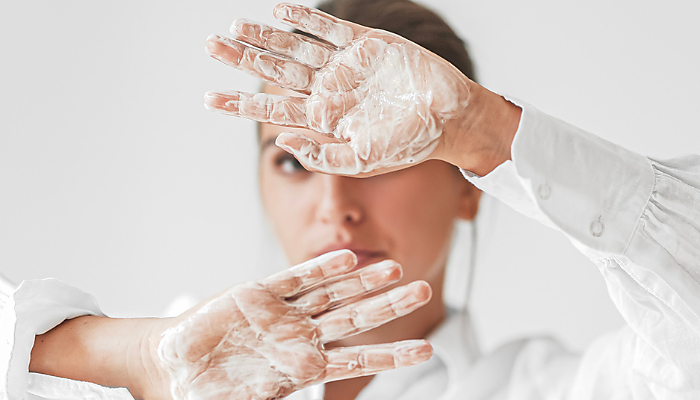
Cleansing is the first and most important step in any skincare routine. It is not just about removing make-up or dust. It determines whether your skin reaches the next step (serum, moisturiser, SPF) ready to absorb active ingredients, or with a weakened barrier. Proper facial cleansing sets the stage for everything that follows. It is also the step where mistakes are most common: water that is too hot, surfactants that are too harsh, or too many steps. Ordinary soap has a pH of 9 to 10, while skin naturally has a pH of 4.5 to 5.5. A difference of three pH units means an environment that is a thousand times more alkaline, from which the barrier takes hours to days to recover. In this guide, we cover types of cleansers, pH, double cleansing, choosing products for your skin type and the ingredients we rely on at Dulcia: soap nuts as a source of cleansing agents and the konjac sponge as a natural alternative to now-banned microbeads.
Why cleansing is the foundation of healthy skin
Cleansing removes impurities, excess sebum, dead skin cells, SPF residue and make-up, which would otherwise form a film that blocks the absorption of active ingredients. At the same time, it must respect the skin barrier. Overly harsh cleansing disrupts the barrier just as not cleansing does. It removes not only impurities but also protective lipids, and raises the skin's pH by several units.
A study by Del Rosso and Levin (J Clin Aesthet Dermatol, 2011) showed that barrier dysfunction precedes clinical signs of irritation. By the time you see redness, the underlying barrier has already been damaged for several hours. TEWL (transepidermal water loss) in healthy skin is around 5 g/m²/h; after washing with harsh surfactants, it can increase five- to tenfold.
Paradoxically, “less cleansing” is not the answer for dry skin. A well-formulated cleanser is. Without the right cleanser, sebum and SPF residue bind to acids on the skin and form an occlusive film that obstructs the active ingredients in your night cream. In our retinol guide, we explain why cleansing before applying a potent active ingredient is a technical requirement in its own right, not just a hygiene formality.
Why pH matters: what rarely gets discussed
Healthy skin has a pH of 4.5 to 5.5. Ordinary toilet soaps have a pH of 9 to 10. After washing with soap, the skin's pH rises by an average of three units and only returns to its baseline after 90 minutes (Jungersted et al., Pediatr Dermatol, 2010). During this time, the barrier is disrupted, lipid renewal slows down and the microbial environment changes, which is enough to trigger irritation in susceptible skin.
A study by Tarun et al. (Indian J Dermatol, 2014), which measured the pH of 32 commercial soaps and 38 shampoos, produced concerning findings. As many as 96% of ordinary soaps had a pH of 9–10. Only 3.125% had a pH close to that of skin. The picture was more favourable for shampoos (most had a pH of 6–7), but soap intended for the body and sometimes the face remains largely alkaline.
A difference of three pH units is not linear. pH is a logarithmic scale, so pH 9 compared with pH 6 means an environment that is a thousand times more alkaline. This environment disrupts the activity of kallikreins, the enzymes responsible for natural desquamation (the shedding of dead skin cells), and changes the composition of the surface microbiome. Full barrier recovery after repeated alkaline disruption can take 14 to 17 days (Nguyen et al., J Invest Dermatol, 2024).
Unlike soap, syndets (synthetically formulated cleansers) can be formulated at pH 5.5, arguably the biggest cosmetic innovation of recent decades (Draelos, J Cosmet Dermatol, 2018). So the first question when choosing a cleanser is: what is its pH? If the manufacturer does not state it, ask.
Types of cleansers: a comparison
There are seven main types of cleansers on the market. Each suits a different skin type and situation. The most important difference is not the marketing, but the surfactant and pH.
| Cleanser type | How it works | Suitable for | What to watch out for |
| Traditional soap | Saponified fatty acids, pH 9–10 | Body, hands | Rarely suitable for the face; raises skin pH by 3 units for 90 minutes |
| Syndet (synthetic cleanser) | Synthetic surfactants (SCI, glucosides), pH 5.5 | All facial skin types, including sensitive | Quality varies; read the ingredients |
| Cleansing gel | A combination of gentle surfactants in a water base | Normal, combination and oily skin | SLS and SLES content indicates harshness |
| Foaming cleanser | Surfactants combined with gas in a foaming dispenser | Oily and combination skin | More foam does not mean better cleansing |
| Cream cleanser | Oil-in-water emulsion with minimal surfactants | Dry and very dry skin | Less effective at removing heavy make-up |
| Oil cleanser | Oils dissolve sebum and SPF (like dissolves like) | All skin types in an evening routine | Requires a second step for heavy make-up |
| Micellar water | Surfactant micelles trap impurities | Quick cleansing, travel, sensitive skin | Does not replace thorough washing when wearing SPF |
| Konjac and natural sponges | Gentle physical exfoliation and water | All skin types, including sensitive | Not for daily use on reactive skin |
Comparison summary:
In the morning, the gentlest cleanser is enough (water and a syndet or light gel). In the evening, if you wear SPF and make-up, consider double cleansing. Dermatological literature (Mukhopadhyay, Indian J Dermatol, 2011; Mijaljica et al., Molecules, 2022) ranks surfactants from harshest to mildest as follows: traditional soap, SLS, SLES, betaines, amino acid sarcosinates, alkyl polyglucosides (APG), sucrose esters and natural saponins.
What soap nuts are and why we chose them
Soap nuts are the fruits of Sapindus trifoliatus and Sapindus mukorossi trees. They contain 10 to 11.5% natural saponins, triterpene glycosides that act as non-ionic surfactants (Sharma et al., J Chem, 2013). Saponins cleanse gently because, compared with sulphates, they cause less disruption to the proteins of the stratum corneum and have additional antimicrobial effects without irritation potential.
Botanically, these are trees that grow in Nepal and northern India. Their fruits were traditionally used in South Asia as a natural laundry detergent for centuries before chemistry explained why they worked. Saponins are glycosides: molecules with a triterpene aglycone (sapogenin) and a sugar chain. Their critical micelle concentration is low (0.05 to 0.1%), meaning they act as surfactants at very low concentrations and do not require harsh quantities in a cleanser (Halla et al., Molecules, 2018).
Hederagenin saponins from Sapindus mukorossi have demonstrated antimicrobial activity against Staphylococcus aureus, Escherichia coli and Candida at concentrations of 100 to 500 µg/mL (Sharma et al., 2013). They are also biodegradable, do not bioaccumulate and have received the EU EcoLabel as environmentally acceptable cleansing agents.
A note for allergy sufferers: despite their name, soap nuts are not nuts in the allergological sense. They belong to the Sapindaceae (soapberry) family, not Juglandaceae or Anacardiaceae. They are safe for people with nut allergies.
Double cleansing: when it helps and when it does not
Double cleansing means washing your face in two stages in the evening. First, use an oil or emulsion cleanser to dissolve SPF and make-up, then a gel cleanser to remove oily residue. It makes sense for heavy make-up and water-resistant SPF, not every evening.
The reason is measurable. Teo et al. (J Cosmet Dermatol, 2019) showed that water alone leaves 54% of water-resistant SPF residue on the skin, while an oil cleanser leaves only 13.4%. With ordinary, non-water-resistant SPF, the difference between water and cleanser is smaller, and a single cleanse is often enough. The principle is chemical and is known in the skincare community as “like dissolves like”. The oily components of make-up and water-resistant filters dissolve best in oil, while the second step removes water-soluble residue.
When double cleansing makes sense:
- water-resistant SPF
- heavy make-up (foundation, mascara, bold lipstick)
- heavily polluted air (urban roads, travel)
When double cleansing is unnecessary and may harm your skin:
- minimal or no make-up
- light, non-water-resistant SPF
- reactive skin that responds to more frequent washing with stinging and redness
In a Dulcia combination, the first step is usually the Nourishing Cleansing and Make-up Removing Emulsion (Tegosoft® pc 41, BIO castor oil, organic rose water), followed by the Soap Nut Cleansing Gel or 3-in-1 Cleansing Gel with Ceramides.
How to choose a cleanser for your skin type
Dry skin tolerates only the gentlest surfactants and oil cleansing; oily and combination skin benefits from a gel syndet with a pH of 5.5; sensitive skin, rosacea and seborrhoea need formulations without sulphates, fragrance or alcohol; acne requires a combination of gentle cleansing and BHA. According to Mukhopadhyay (Indian J Dermatol, 2011), the right cleanser is part of treatment for all these conditions, not an optional extra.
Dry and very dry skin: a cream or oil cleanser, lukewarm water below 37 °C, no SLS-based foaming products.
Oily skin: a gel cleanser with gentle surfactants. Do not overdo it: more cleansing does not mean less sebum; the skin responds with compensatory secretion.
Combination skin: a syndet with a pH of 5.5; double cleanse depending on the day.
Sensitive and reactive skin: formulations without SLS, SLES, fragrance or alcohol; a short ingredient list.
Rosacea: gentle cleansing is a central pillar. See our rosacea guide for details.
Seborrhoea: paradoxically, excessive oil removal makes the condition worse. See our seborrhoea guide for details.
Acne-prone skin: a syndet with a lower concentration of salicylic acid, 1 to 2× daily, without physical exfoliants.
For skin prone to pigmentation changes (for example, after inflammatory acne or summers in the sun), read our guide to pigmentation spots. Supporting the barrier in sensitive skin is part of addressing pigmentation, not a separate skincare goal.
Morning versus evening cleansing: two different scenarios
In the morning, a gentle gel cleanser is enough. Nothing significant builds up on the skin overnight, just sebum and cream residue. The evening routine is different: you need to remove SPF, make-up, urban pollution and the day's sebum. Morning “deep cleansing”, commonly recommended in marketing, is unnecessary and often needlessly disrupts the barrier that has been repairing itself overnight.
A quick note on water: according to data from the Public Health Authority of the Slovak Republic, approximately 75% of Slovakia's population lives in areas with moderately hard or hard water. Water is softer in eastern Slovakia and harder in the west. Hard water (high in Ca²⁺ and Mg²⁺) reduces rinsing effectiveness when using a surfactant cleanser; calcium ions bind to SLS and leave residue on the skin that increases irritation. A study by Perkin et al. (J Allergy Clin Immunol, 2016) even found up to an 87% higher risk of atopic eczema in hard-water areas in three-month-old babies. For customers in Bratislava and the surrounding area, this has a practical implication: if your skin feels “tight” after washing even with a gentle cleanser, try a final rinse with filtered water or switch to a cleanser with a lower sulphate content.
Common cleansing mistakes
The most common mistakes we see in our customers' routines: hot instead of lukewarm water, harsh cleansing on dry skin, using traditional soap on the face, physical scrubs with plastic microbeads (banned in rinse-off products in the EU since October 2023) and rubbing the skin with a towel. Each of these mistakes directly affects the barrier.
Hot water above 37 °C dissolves sebum faster, accelerates TEWL and triggers an immediate reaction in eczema-prone skin (Engebretsen et al., JEADV, 2016). Lukewarm water is recommended, ideally just below body temperature.
Harsh foaming cleansers on dry skin. In clinical studies, SLS at a concentration of 0.5% in a 24-hour occlusive patch test increased TEWL from 5.1 to 42.6 g/m²/h, approximately eightfold, with a reaction lasting 7 to 9 days. Even in healthy individuals.
Ordinary toilet soap on the face. 96% of soaps have a pH of 9–10. Skin feels “squeaky clean” after washing, but in reality the barrier is temporarily disrupted and compensatory sebum secretion is activated.
Physical scrubs with microbeads. From 17 October 2023, EU Regulation 2023/2055 banned intentionally added microplastics in rinse-off cosmetics. Natural alternatives (konjac sponges, enzyme exfoliants, salicylic acid) have long existed. Anyone still using an old scrub containing “microbeads” from their supplies should replace it.
Rubbing the skin with a towel. This causes microtrauma to the epidermis, adding unnecessary mechanical stress when repeated daily. The solution: gently press a clean cotton towel against your skin and let any remaining water air-dry.
At Dulcia: cleansing as the start of every routine
At Dulcia, we formulate cleansers according to one principle: gentle yet effective. When we developed our Soap Nut Cleansing Gel years ago, we chose an unusual combination: saponins from Sapindus trifoliatus extract, plant-derived sucrose esters (sucrose laurate, sucrose stearate) and oat lipid. Saponins act as non-ionic surfactants; their critical micelle concentration of 0.05 to 0.1% places them among the gentlest natural cleansing agents (Halla et al., Molecules, 2018). In practice, this means skin does not feel tight after washing, the barrier remains intact and the microbiome has room to recover.
In addition, by 2023, when the EU formally banned intentionally added microplastics in rinse-off cosmetics, we already offered a natural alternative: a konjac sponge made from Amorphophallus konjac, 100% biodegradable, with a lifespan of 6 to 8 weeks with regular use. Konjac is a traditional Japanese plant used to make a gel-like sponge that is gentler than a cotton pad, ideal for use with a cleansing gel in both morning and evening routines.
In our reviews, customers most often mention two effects: a reduction in post-wash “tightness” within two to three weeks, and good tolerance in routines where other cleansers caused stinging. For us, these are signs confirming that a gentler surfactant is not a compromise, but the right formulation choice.
Recommended Dulcia facial cleansing products
Soap Nut Cleansing Gel (100 ml)
Our clear number one. Saponins from Sapindus trifoliatus fruits combined with sucrose esters and oat oil. A pH close to that of skin, free from SLS and SLES, with no conventional fragrance (only a gentle citrus essential oil). Suitable for all skin types, including sensitive and acne-prone skin. Find out more on the product page.
3-in-1 Cleansing Gel with Ceramides (100 ml)
99.1% natural ingredients, fragrance-free, vegan. Ceramide Complex CLR™, hyaluronic acid, organic cactus extract AquaCacteen™. Ideal for very dry and sensitive skin, rosacea and barrier dysfunction. Details on the product page.
Nourishing Cleansing and Make-up Removing Emulsion (100 ml)
An oil-and-water emulsion. Tegosoft® pc 41, BIO castor oil, organic rose water. The first step in double cleansing to remove heavy make-up and SPF in the evening.
Natural BIO Micellar Water (100 ml)
Micellar surfactants, organic rose water, allantoin, panthenol. For quick make-up removal, travel and sensitive skin. A complement to thorough cleansing, not a replacement.
Konjac Sponge
A 100% natural sponge made from Amorphophallus konjac, 100% biodegradable. Gentle mechanical cleansing and skin massage. Soak in warm water before use, then rinse and leave to dry afterwards. Lasts 6 to 8 weeks with regular use. Find out more on the product page.
Frequently asked questions
How many times a day should I cleanse my skin?
Twice: lightly in the morning (with lukewarm water and, if needed, a gentle gel), and more thoroughly in the evening. A third time after exercise if you have been sweating. More than three times a day disrupts the barrier and triggers a compensatory increase in sebum production in many skin types. With rosacea and reactive skin, water alone in the morning and a gentle cleanser in the evening may sometimes be enough.
Do I need to double cleanse every evening?
No. Double cleansing makes sense for heavy make-up and water-resistant SPF (an oil cleanser removes approximately 86% of SPF residue compared with 46% for water alone). On an ordinary day with light or no make-up, one step is enough. Double cleansing every evening puts unnecessary strain on the barrier of sensitive skin.
Is micellar water enough to cleanse my skin?
For quick make-up removal, yes, especially when travelling or if you have sensitive skin. It is not enough to replace a thorough evening wash when wearing SPF, because residue remains in pores and oily areas. Ideally, use micellar water as the first step to remove make-up, followed by a cleansing gel and water.
Can I use ordinary soap on my face?
We do not recommend it. 96% of ordinary soaps have a pH of 9–10 (Tarun et al., 2014), while skin has a pH of 4.5–5.5. A single wash with soap raises skin pH by three units and keeps it there for up to 90 minutes. During this time, the barrier is weakened and the microbiome disrupted. Choose a syndet or a natural cleanser formulated at pH 5.5.
How often should I use a konjac sponge?
For normal skin, 2 to 3× a week; for sensitive skin, 1× a week. Before use, soak the sponge in warm water to soften it. After use, rinse, gently squeeze out excess water and leave to dry. Sterilise in hot water for 1 to 2 minutes once a week. Lasts 6 to 8 weeks with regular use.
What should I do if my skin feels “tight” after washing?
Tightness indicates a disrupted barrier and depleted lipids. A short-term solution: switch to a gentler cleanser (a syndet with a pH of 5.5 or a saponin-based product), lower the water temperature to below 37 °C, and apply a hydrating serum or moisturiser immediately. If the feeling persists for weeks, consult a dermatologist. It could be atopic or sebostatic dermatitis.
Conclusion
Cleansing is the first crucial step. Not because it is more photogenic than a serum or moisturiser, but because it determines the condition your skin is in when everything else follows. An acid mantle at pH 4.5 to 5.5, intact ceramides in the stratum corneum, a balanced microbiome: all of these depend on whether your cleanser is formulated with respect for your skin. At Dulcia, we do not rely on powerful foam and harsh surfactants. We rely on soap nuts, sucrose esters, ceramides and natural sponges. It is gentle, it is effective, and after years of use it delivers the same result as in the first week: healthy skin that does not need to be “revived” with cream after every wash.
Browse our full cleansing range or read our story.
Sources
Ananthapadmanabhan KP, Moore DJ, Subramanyan K, Misra M, Meyer F. „Cleansing without compromise: the impact of cleansers on the skin barrier and the technology of mild cleansing." Dermatol Ther 2004; 17 Suppl 1:16–25. PMID: 14728695.
Mukhopadhyay P. „Cleansers and their role in various dermatological disorders." Indian J Dermatol 2011; 56(1):2–6. PMID: 21572782.
Draelos ZD. „The science behind skin care: Cleansers." J Cosmet Dermatol 2018; 17(1):8–14. PMID: 29231284.
Tarun J, Susan J, Suria J, Susan VJ, Criton S. „Evaluation of pH of Bathing Soaps and Shampoos for Skin and Hair Care." Indian J Dermatol 2014; 59(5):442–444. PMID: 25284846.
Lambers H, Piessens S, Bloem A, Pronk H, Finkel P. „Natural skin surface pH is on average below 5." Int J Cosmet Sci 2006; 28(5):359–70. PMID: 18489300.
Nguyen HL, Liang G, Sahar N, et al. „The Skin Acid Mantle: An Update on Skin pH." J Invest Dermatol 2024; 144(10):2174–2184. PMID: 39243251.
Del Rosso JQ, Levin J. „The Clinical Relevance of Maintaining the Functional Integrity of the Stratum Corneum in both Healthy and Disease-affected Skin." J Clin Aesthet Dermatol 2011; 4(9):22–42. PMID: 21938268.
Mijaljica D, Townley JP, Spada F, Harrison IP. „Skin Cleansing without or with Compromise: Soaps and Syndets." Molecules 2022; 27(6):2010. PMID: 35335373.
Teo CW, Tay SH, Tey HL, Ung YW, Yap WN. „The optimal cleansing method for the removal of sunscreen: Water, cleanser or cleansing oil?" J Cosmet Dermatol 2019; 18(6):1750–1755. PMID: 31157512.
Halla N, Fernandes IP, Heleno SA, et al. „Cosmetics Preservation: A Review on Present Strategies." Molecules 2018; 23(7):1571. PMID: 29958370.
Sharma A, Sati SC, Sati OP, Sati D, Kothiyal SK. „Triterpenoid Saponins from the Pericarps of Sapindus mukorossi." J Chem 2013; Article ID 218510.
Commission Regulation (EU) 2023/2055 of 25 September 2023 amending Annex XVII to REACH (Microplastics restriction). Entry into force: 17 October 2023.
Jungersted JM, Høgh JK, Hellgren LI, Jemec GB, Agner T. „Effects of soap and detergents on skin surface pH, stratum corneum hydration and fat content in infants." Pediatr Dermatol 2010; 27(2):123–8.
Engebretsen KA, Johansen JD, Kezic S, Linneberg A, Thyssen JP. „The effect of environmental humidity and temperature on skin barrier function and dermatitis." JEADV 2016; 30(2):223–249. PMID: 26449379.
Perkin MR, Craven J, Logan K, et al. „Association between domestic water hardness, chlorine, and atopic dermatitis risk in early life." J Allergy Clin Immunol 2016; 138(2):509–516. PMID: 27241892.
Public Health Authority of the Slovak Republic. Drinking water hardness in Slovakia (public data).


